
Single Route vs Multi-Route SMS Strategy — Which Delivers Better OTP and Marketing Performance?
In today’s fast-moving digital economy, SMS remains one of the most reliable communication channels for businesses worldwide. Whether it is OTP verification, promotional campaigns, membership notifications, or iGaming engagement, enterprises continue to depend on SMS because of its exceptional delivery speed, high open rate, and direct customer reach.
However, not all SMS routing strategies are built the same. One of the most important decisions businesses face when selecting a global SMS provider is whether to use a single route SMS strategy or a multi-route SMS strategy. The difference can directly impact delivery rates, security, latency, scalability, and overall campaign ROI.
At Texcell Messaging, we help businesses optimize international messaging performance through intelligent routing solutions tailored for OTP verification, enterprise notifications, eCommerce promotions, and iGaming marketing traffic.
What Is a Single Route SMS Strategy?
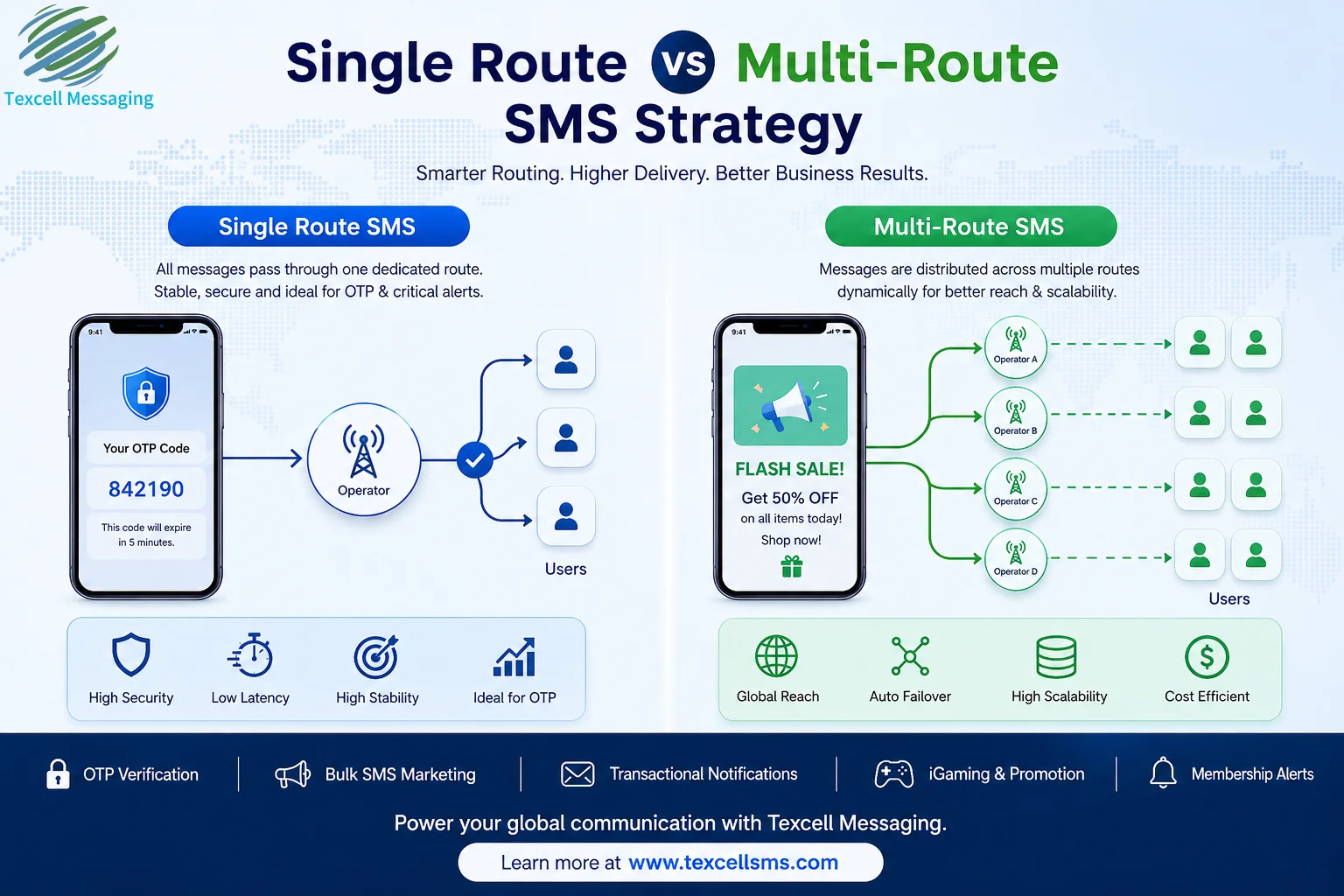
A single route SMS strategy means all SMS traffic is transmitted through one dedicated carrier route or supplier path. This approach is commonly used for sensitive and mission-critical traffic such as OTP authentication, banking alerts, security verification codes, and transactional notifications.
The primary advantage of a single route SMS setup is consistency. Businesses can expect more predictable delivery behavior, lower latency, and stronger control over message quality. Since the traffic follows a stable carrier connection, OTP SMS provider performance becomes easier to monitor and optimize.
For industries where timing is everything, including fintech, cryptocurrency platforms, and iGaming operators, delayed OTP codes can lead to failed logins, abandoned registrations, and lost revenue.
Texcell Messaging provides high-quality dedicated routes engineered for businesses that prioritize security, speed, and delivery reliability.
What Is a Multi-Route SMS Strategy?
A multi-route SMS strategy distributes SMS traffic across multiple carrier paths and suppliers dynamically. Instead of relying on a single connection, the system automatically selects the most suitable route based on destination, traffic volume, pricing, and real-time performance.
This model is widely adopted for bulk SMS service campaigns, flash sales, promotional messaging, and international large-scale traffic distribution.
The major advantage of multi-route SMS is flexibility and scalability. Businesses can maintain message continuity even if one route experiences congestion or temporary delivery issues. Multi-route systems also improve global reach by accessing localized carrier connections in different countries.
For example, during major shopping events or iGaming promotions, traffic spikes can overwhelm a single route. Multi-route architecture helps balance the load while maintaining strong delivery performance.
Single Route vs Multi-Route SMS: Which One Should You Choose?
The answer depends on your business goals and messaging scenarios.
If your primary focus is secure OTP delivery, account verification, or banking-level authentication, a single route SMS strategy is often the preferred choice. Stability and speed are critical in these environments.
On the other hand, if your business sends large-scale marketing campaigns across multiple regions, a multi-route SMS approach provides better scalability and cost optimization.
Many global enterprises today combine both strategies. They use premium single routes for OTP traffic and multi-route configurations for promotional campaigns. This hybrid strategy improves both operational efficiency and customer experience.
Why SMS Still Matters in Modern Business
Despite the growth of messaging apps and social platforms, SMS continues to outperform many digital channels in critical communication scenarios. SMS does not require internet access, app installations, or user behavior algorithms.
Studies consistently show that SMS messages achieve significantly higher open rates compared to email marketing. For OTP verification and urgent notifications, SMS remains the fastest and most trusted channel.
Industries such as eCommerce, finance, logistics, SaaS platforms, healthcare, and iGaming rely heavily on global SMS gateway infrastructure to ensure uninterrupted customer communication.
At Texcell Messaging, our infrastructure is designed to support:
- Global OTP verification delivery
- Promotional bulk SMS campaigns
- Membership and transactional notifications
- iGaming traffic messaging solutions
- Real-time delivery monitoring
- Intelligent routing optimization
How Texcell Messaging Optimizes Global SMS Delivery
Modern SMS delivery requires more than simple carrier access. Businesses need routing intelligence, regional expertise, compliance management, and performance analytics.
Texcell Messaging combines direct carrier connectivity, route optimization technology, and real-time monitoring systems to improve delivery rates worldwide.
Our global SMS gateway infrastructure supports enterprises looking for scalable and secure international messaging solutions.
Whether your business needs premium OTP delivery or high-volume bulk SMS service distribution, our routing specialists help identify the optimal strategy based on your target markets and operational goals.
Final Thoughts
Choosing between single route SMS and multi-route SMS is not simply a technical decision. It is a strategic business choice that influences customer experience, security, conversion rates, and operational scalability.
For OTP authentication and mission-critical messaging, single routes provide stability and precision. For international marketing campaigns and large-scale promotions, multi-route systems deliver flexibility and scalability.
Texcell Messaging helps businesses combine both approaches into a high-performance global messaging strategy.
Ready to improve your international SMS performance? Get started now and discover how Texcell Messaging can support your global communication growth.